



Skip to content
  • There are no suggestions because the search field is empty.

CatiBovin combines targeted calcium and nitrogen supplementation
to promote glutamine production in dairy cows.
Energy metabolism remains stable and feed conversion is improved.
This allows cows to fully extend their performance potential throughout all stages of lactation.

A minimalist, dark blue line drawing depicting two laboratory Erlenmeyer flasks. Liquid drips from the upper flask into the lower, filled vessel, which contains bubbles—symbolizing scientific research and product development at PerformaNat.
Over 10 years of research
A minimalist, dark blue line drawing depicting a stick figure in a proud superhero pose, with arms akimbo and a flowing cape—symbolizing the strengths of PerformaNat.
8 scientific publications
A minimalist, dark blue line drawing depicting a spotted dairy cow with udders in profile—symbolizing the health, vitality, and well-being of dairy cows at PerformaNat.
Over 150 satisfied customers
Challenges

Nutrient deficiencies decrease performance and cost money

In the weeks around calving, the need for energy, calcium and protein increases significantly. At the same time, the cow and her metabolism must cope with many changes — The metabolism is quickly put under strain.

Many farms are familiar with the consequences: lower milk yield, fluctuating performance, increased metabolic stress and decreased feed efficiency. Heat stress or a change in feed further intensifies the situation.

CatiBovin supports precisely here: It improves the utilisation of calcium and nitrogen, increases glutamine production and contributes to consistent performance. The supplementary feed is based on over 10 years of research, has been scientifically tested and is already being used successfully on more than 150 dairy farms.

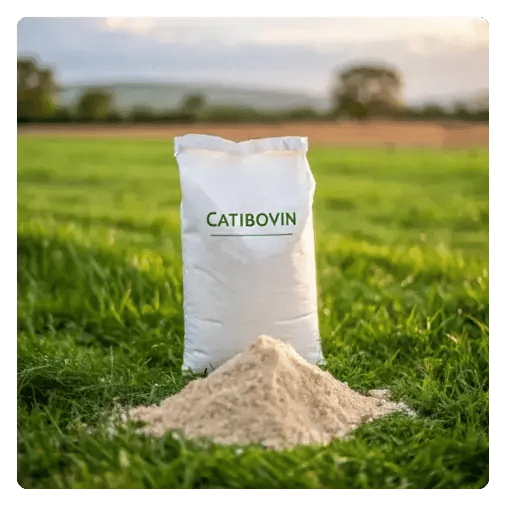
A white bag of PerformaNat's Catibovin dietary supplement stands in a green meadow. In the foreground, a small pile of the light-colored powder lies on the grass.

PerformaNat CatiBovin (25 kg)

Optimised nutrient uptake out of the rumen for healthy cows 

CatiBovin is a feed supplement for dairy cows that promotes the absorption of calcium and nitrogen in the rumen. Increased nitrogen in the metabolism leads to higher glutamine production in the liver. Glutamine is a key amino acid for milk production and metabolic processes. At the same time, improved feed efficiency can contribute to more consistent performance.

PRODUCT FEATURES:

  • Powdered formulation– easily mixed into the TMR or concentrate

  • Suitable for daily use, even beyond calving

  • Higher milk yields (+2.1 to 4.8 kg ECM/day)

  • Lower BHB levels and reduced metabolic stress
  • More stable Body Condition Score (BCS)
A yellow-and-black graphic by PerformaNat depicting a cow grazing or eating with its head lowered against a black background.

Question

When should you use CatiBovin in your herd?

Answer
CatiBovin supports your cows during periods of high demand—around calving, during early lactation or when they experience heat stress or feed changes. It improves nitrogen utilisation, promotes glutamine production and thus contributes to increased milk yields, improved feed efficiency and a reduced metabolic stress.

how it works

The Benefits of CatiBovin

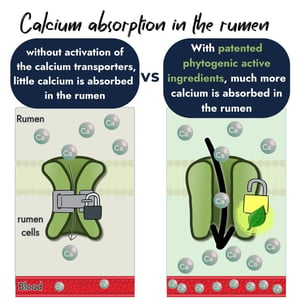
Infographic comparing calcium absorption in the rumen. Left shows a locked transporter with little absorption. Right shows an unlocked transporter using patented phytogenic active ingredients, allowing much more calcium into the blood.

Most calcium absorption takes place in the rumen and can be enhanced

Our patented phytogenic active ingredients increase calcium absorption in the rumen by activating the existing calcium transport channels.

By activating the transport channels in the rumen tissue, calcium can be transported more quickly from the rumen into the bloodstream. In experiments on isolated rumen tissue, it was also demonstrated that long-term use leads to a training effect on the channels.
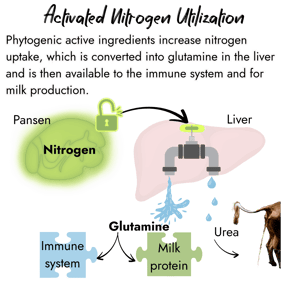
An educational graphic showing nitrogen uptake in the rumen released to the liver, turning on a faucet to support the cow's immune system and milk protein production.The phytogenic active ingredients in CatiBovin stimulate nitrogen uptake in the rumen, thereby increasing overall nitrogen utilisation.

In the liver, this nitrogen is then used to produce more glutamine, which is needed for milk protein synthesis and general immune function. At the same time, the liver produces less urea, further increasing nitrogen utilisation. Nitrogen losses via milk urea and urine are reduced.
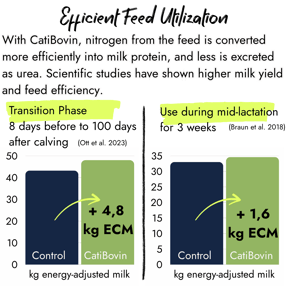
Bar plot comparing control vs. CatiBovin treatment, demonstrating an increase of +4.8 kg ECM in the transition phase and +1.6 kg ECM during mid-lactation.


CatiBovin improves nitrogen utilisation from feed. The liver produces less urea and more glutamine, an essential amino acid for milk protein synthesis. Better utilisation of nitrogen from the feed increases both feed efficiency and milk yield: in early lactation (+4.8 kg ECM) and also in mid-lactation (+1.6 kg ECM).
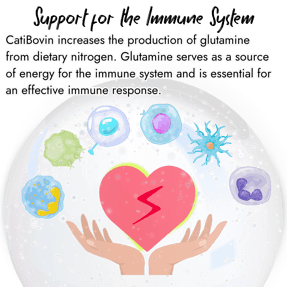
An illustration inside a protective glass bubble showing immune cells surrounding a glowing heart supported by hands, explaining CatiBovin's role in glutamine production for cattle immune defense.

The immune system needs glutamine as a source of energy and protein for the division and activation of immune cells and for the production of signalling molecules.

With CatiBovin, more nitrogen is absorbed from the feed and converted into glutamine, which supports healthy immune function.
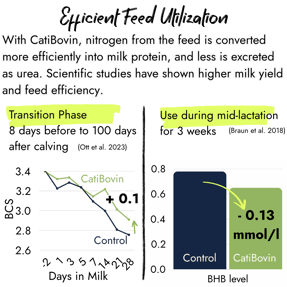
A study chart showing CatiBovin's effect on dairy cow metabolism, highlighting a 0.13 mmol/l reduction in blood BHB levels compared to the control group.

CatiBovin measurably reduces metabolic stress

Despite higher milk yields, studies have shown that less body mass was lost in the first 3 weeks after calving (lower loss in Body Condition Score [BCS]). In addition, lower BHB levels were measured, indicating a more stable energy balance.

 Success Stories with CatiBovin 

 Success Stories with CatiBovin:

"Since we started using CatiBovin, our cows are healthier, the start of lactation is smoother and we hardly ever see milk fever anymore."

Herd manager Florian Kindermann shares his experiences with CatiBovin


What our customers say

"Within the first two weeks, I already saw a significant increase in feed intake and a rise in milk yield of about 1.5 kg per cow per day. The cows simply entered lactation better and remained more stable."

Wolfram Gräßer, Dobareuth Agricultural Cooperative, Gefell, Germany - 450 cows

CatiBovin contains phytogenic active ingredients that improve the absorption of calcium and nitrogen in the rumen. More nitrogen is converted in the liver into glutamine, a key amino acid for milk production, feed efficiency and metabolic processes.

For farms, this means:

  • More consistent milk production throughout lactation

  • Better feed efficiency and lower feeding costs per litre of milk

  • Reduced metabolic stress during critical phases

  • Greater stability during heat stress or feed changes

  • Potential for fewer metabolic problems and reduced veterinary costs

The effects of CatiBovin have been examined in several scientific studies. Among other things, the following were observed:

  • an increase in milk yield of up to 4.8 kg ECM per day

  • more stable blood calcium levels at calving

  • lower BHB levels

  • reduced BCS loss

The studies were conducted under field conditions and published in professional journals, including the Journal of Dairy Science.

A calcium bolus provides a short-term supply of highly bioavailable calcium, for example, around the time of calving. CatiBovin works differently: it supports the long-term absorption of calcium and nitrogen from the feed, thereby promoting metabolism throughout the entire lactation period. Both products can be used together.

A stable calcium balance reduces the risk of milk fever. CatiBovin improves calcium absorption from feed, thereby providing support, especially during the period around calving.

A field report from a dairy farm shows:

“On our farm, all cows in the close-up group and all newly calved cows receive CatiBovin. Since I started using it, the cows have entered lactation in better health and condition, and they have shown very good production performance. Since starting seven months ago, I have had almost no cases of milk fever anymore.”

Ideally, administration should begin during the close-up phase.

CatiBovin is fed daily at a dose of 30 g per animal as part of the feed ration.

Thanks to its powdered formulation, it can be easily mixed into the TMR or concentrate feed. No adjustment to the rest of the ration is necessary.

Yes, the positive effects are also evident during lactation.

Studies have shown several benefits, including lower urea levels and improved feed efficiency. Continuous support for metabolism can also be beneficial during stressful situations, such as heat stress or feed changes.

To maximise the benefits, we recommend continuous feeding. At a minimum, however, feeding should begin at least three weeks before calving and continue through the peak of lactation.

Increased glutamine production ensures that immune cells have more energy. This strengthens the immune system, particularly during periods of heat stress, calving or feed changes.

CatiBovin has been used in a wide variety of feeding trials. No interactions were observed either in these trials or among our customers who are already using CatiBovin successfully. Please feel free to contact us if you have any specific questions.

Katharina Schrapers blickt freundlich in die Kamera. Sie ist bei PerformaNat Ansprechpartnerin in der Produktentwicklung.HAVE WE SPARKED YOUR INTEREST?

Request a free consultation now

Katharina Schrapers blickt freundlich in die Kamera. Sie ist bei PerformaNat Ansprechpartnerin in der Produktentwicklung.HABEN WIR IHR INTERESSE GEWECKT?

Jetzt kostenlose Beratung anfragen